 Invariance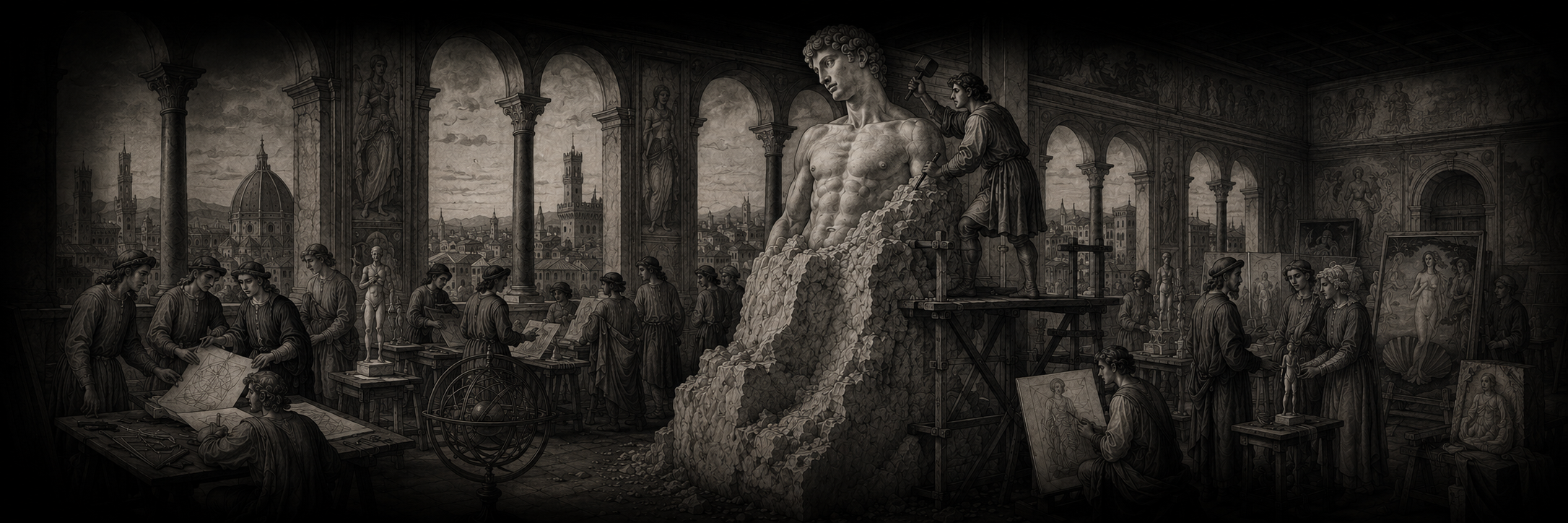
The Second Renaissance
The first Renaissance was born from someone who couldn’t paint or sculpt.
Lorenzo de’ Medici had no hands for it. What he had was taste, conviction, and the means to find genius and set it free. He discovered Michelangelo at fifteen and put him to work in his sculpture garden. He didn’t make the David. He found the boy who could, and handed him the marble.
We believe AI is what makes a new Lorenzo possible.
Most of it is built to extract, to make the human a faster machine, cheaper output from the same tired hands. But that was never what it was for. AI cannot make the meaningful work itself, and for exactly that reason it is the perfect instrument of patronage. It is a patron by compression: it collapses the cost of everything that was never the point, the drudgery, the manual labor, the tax we paid to make anything at all, and hands the freed time back to the person. What gold and taste were to Lorenzo, this is to us, only without his limits. He could free one boy in a garden. The right AI, in the right hands, can find them, free them, and let them make the thing only they could make, at a scale he never dreamed of.
This is a rebirth. Last time it was art. This time it’s everything, new economies, a new kind of company, a new world. And it forces a question almost no one is asking:
When making things costs almost nothing, what is a company even for?
The old company turned human labor into products and sold it. The person was an input, labor in, output out. But when the labor is free, that logic falls apart, and you’re left with a truth that was always there and easy to ignore:
We were never meant to be instruments of production.
The drudgery was never the point of us. The labs see AI and think efficiency. We see the tax finally lifting, and the only thing left that was ever really ours: taste, judgment, meaning. The eye that knows what’s good.
So a company stops being a machine for extracting labor and becomes a house for patronage. It curates human taste, compresses everything else with technology, and makes beautiful products, things a machine could never have meant, aimed at a single purpose: not to make you a more efficient producer, but to give you back the room to be a person.
That is what we are building at Invariance: an organization for the patronage of the human experience.
The second Renaissance, on purpose.
— Hardik